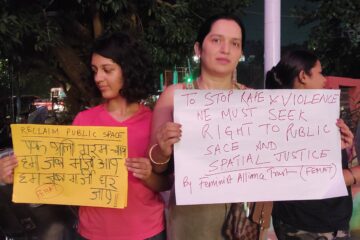
Delhi based nonprofit organization Feminist Alliance Trust (FEMAT) has filed an RTI application with the Ministry of Women and Child Development seeking information on the central government’s compliance with its statutory obligation to give wide publicity to the provisions of Protection of Women from Domestic Violence Act, 2005 (DV Act) through public media.
Section 11 of the DV Act deals with the duties of both central and state governments with regard to protection of women from domestic violence including prevention and capacity building actions. To quote the relevant provisions:
Section 11. Duties of Government
The Central Government and every State Government, shall take all measures to ensure that
- the provisions of this Act are given wide publicity through public media including the television, radio and the print media at regular intervals; (emphasis added)
Through this RTI application, Feminist Alliance Trust seeks to ascertain whether, and in what manner, has the central government obliged with its statutory duty to raise public awareness about the DV Act in the last ten financial years. Information has been sought under various categories, each corresponding to specific actions expected from the central government, from taking own initiatives to raise public awareness to playing the supervisory role and ensure that States and Union Territories are also complying with the same duty.
Firstly, we have asked for the total number of public awareness campaigns undertaken by the Ministry of Women and Child Development during the period of 01.04.2016 to 31.03.2026, along with the total number of campaign disseminated via each public media platform namely, Television, Radio, Print, Outdoor and Digital, and at what intervals.
Secondly, whether the Ministry has any policy document or standard operating procedures (SOP) or guidelines determining the process to be followed in order to ensure that the duties under Section 11 are complied with.
Thirdly, whether the Ministry has any internal mechanism to monitor the compliance status of the State Governments and Union Territory Administrations who are also mandated to raise public awareness about the provisions of DV Act. The RTI application has also sought certified copies of any such notification or order issued by the central government towards the States and Union Territories directing them to publicize the DV Act.
Certified copy of any compliance or action taken reports submitted by the various States and Union Territories regarding the statutory duties under the PWDV Act has also been sought.
The RTI has specifically and purposely kept the questions limited to Section 11 Clause (a) of the DV Act and does not dwell upon Clause (b), (c), and (d) of the same section which deal with other statutory duties such as, train and sensitize members of police and judiciary regarding the DV Act, effective coordination between States and service providers and other stakeholders, and so on. This specific and narrowing down of the information sought was done because while it is publicly known information that central government has organized trainings and sensitization events for members of police and judiciary or the One Stop Centers and other relevant personnel but no information is available on the public domain about any recent mass public awareness.
Prior to filing the RTI application, FEMAT team searched the publicly available information on the websites of the Ministry of Women and Child Development (MWCD) and the National Commission for Women (NCW). Searches for the term “Domestic Violence” were conducted under the categories and sub-categories of Reports, Publications, Orders and Notices on both the websites but did not yield any results. It is also pertinent to note that, in the publicly available lists of Central Public Information Officers (CPIOs) and First Appellate Authorities (FAAs), the MWCD does not appear to have a dedicated CPIO specifically entrusted with matters relating to the DV Act although dedicated CPIOs are identified for subjects such as Anganwadi, Direct Benefit Transfer, e-Samiksha and CARA, among others. It signals the lack of will on the government’s part to take the issue of domestic violence and the implementation of DV Act seriously.
Objective behind the RTI
The RTI was necessitated by the Feminist Alliance Trust’s everyday experience and learnings while running the Free Legal Counselling program. It was found out that even urban, educated and working women with relative freedom and independence do not know about the basics of the PWDVA. For example, PY, a well-educated woman who called the Feminist Alliance Trust seeking guidance on emotional and financial violence she was facing, was completely surprised when she was told that there is a provision of “Compensation Order” under PWDVA that is separate from the maintenance petitions under Section 125 of Cr.P.C. Another woman, RA, an MBBS doctor by profession, who was afraid of going back home at night because of an abusive husband, and whose parents had asked her not to come back and “adjust”, called us for legal counselling. When we told her about Residence Order, she was completely surprised saying, “I had never heard of it.” She was spending her nights at the hospital ward because she did not know where to sleep at night and yet was unaware of the provision of Residence Order under PWDV Act.
These experiences beg the question, if even after 20 years of its enactment, the basic provisions of Protection of Women from Domestic Violence Act remain unknown to even the urban, educated and employed women, who is to be held accountable for that systemic knowledge gap? Who was entrusted with the responsibility to raise awareness? Hence we have asked the government what have they done in the past 10 years to raise awareness about the DV Act.
The public discourse about DV Act is overwhelmingly centered around its misuse. In a recent essay, “On the Domestic Violence Law: How the PWDVA has been domesticated with dubious interpretations”, on The Leaflet, Retd. Justice K. Chandru eloquently explained how the bogey of misuse is highly misplaced. He further noted that the Act has failed to give women the justice they deserve. Yet, his essay too failed to hold the central government accountable for its failures to give wide publicity to the provisions of the law.
Feminist Alliance Trust will examine the information received in response to the RTI and place it in the public domain.
About Feminist Alliance Trust
Feminist Alliance Trust is a registered non-profit organization working on feminist knowledge creation and dissemination, transformative learning and capacity building skills and workshops, free legal aid and intervention (pro-bono legal support for women and use of mechanism such as Right To Information and Public Interest Litigation to foster gender-mainstreaming in governance and institutional reforms), and feminist infrastructure (Short Residency for Women Leaving Violence).
For media and other queries:
Dr. Sanjukta Basu, Advocate
Founder-Settlor, Feminist Alliance Trust.